The Grasp
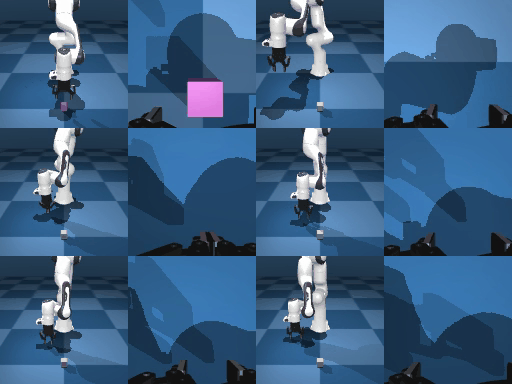
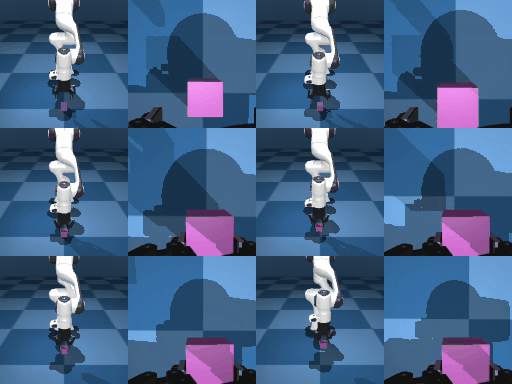
No scripted motion, no imitation objective. One line of reward — +1 if the cube lifts — a vision model that judges success from pixels, and a human who takes over when the arm is about to fail. The recipe is HIL-SERL, and it takes a trembling arm to near-perfect grasping in about forty minutes on one GPU.
The build, step by step
The exact path we followed — and the one you'll follow in the code kit.
One instruction
+1 if you lift the cube. That is everything the arm is told. No demonstrations to copy at the objective level, no hand-coded motion.
A camera judges
A small vision classifier watches the scene and stamps each frame success or failure — the reward itself is learned from pixels.
A human catches it
It starts from 30 teleop demos. Then every training batch mixes 128 human samples with 128 of the robot's own attempts, and the learner runs 20 gradient updates per real step. When the arm is about to fail, a human takes over — and that correction goes straight into the buffer.
The curve takes off
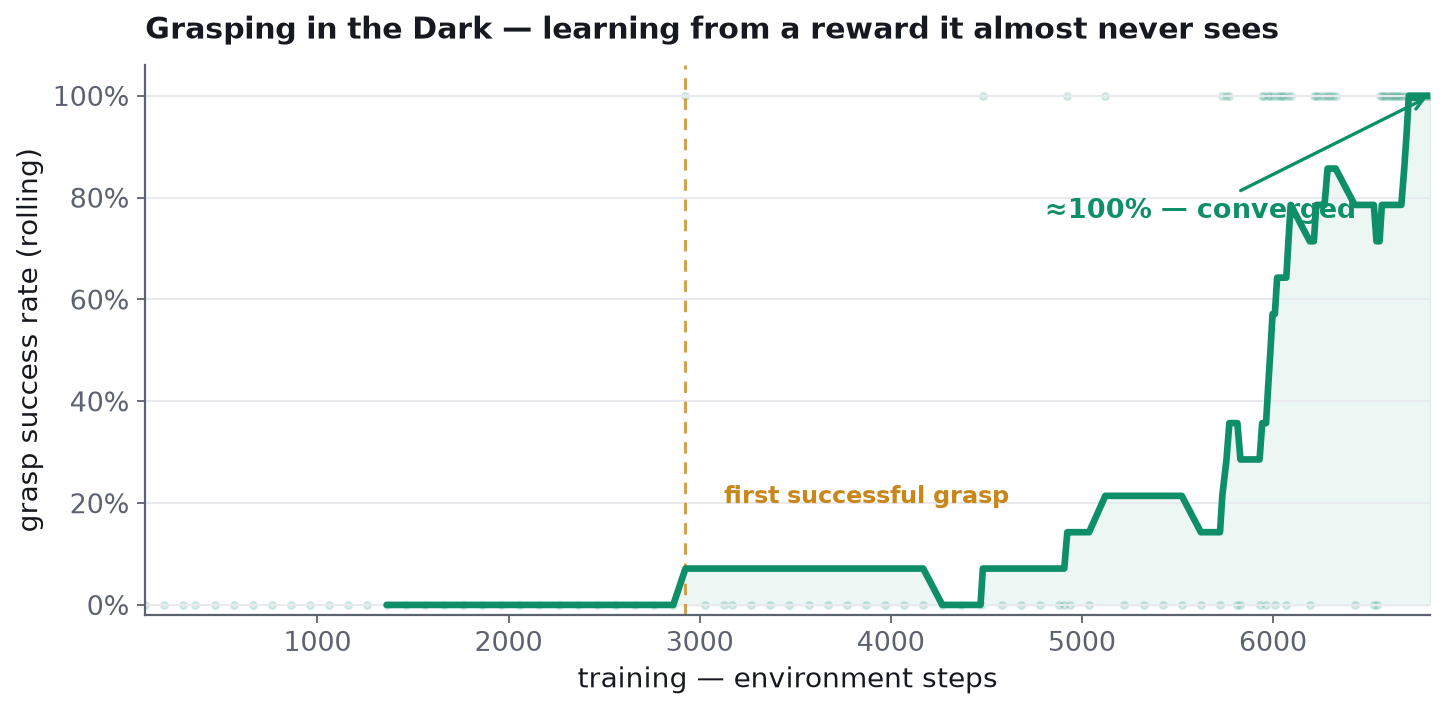
Flat at 0% until the first successful grasp near step 2,900 — then the prior-data blend compounds the climb to ~100% by step 6,800. About forty minutes on a single GPU.
Sim to real
The same code, pointed at a real $200 SO-101 arm: 15–25 fresh teleop demos, a reward classifier trained on real images, and near-perfect grasping in under three hours.
From the run